Responding to self-harm and suicidal crises requires more than good intentions. When someone is in crisis, the first step is often simple but difficult: do not make it worse.
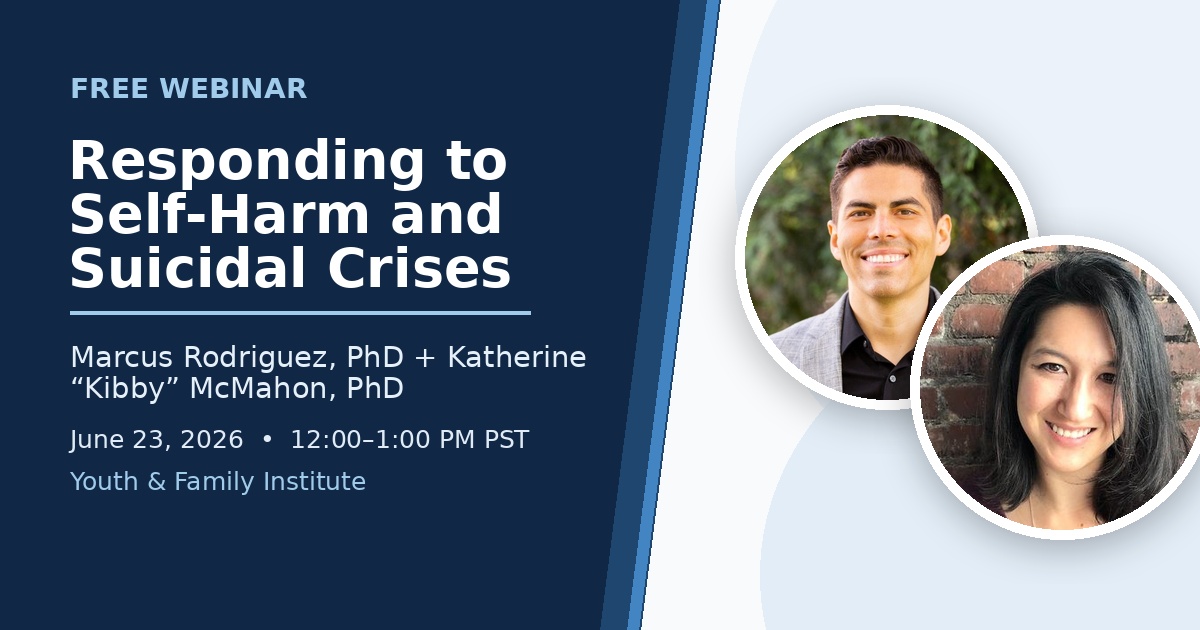
Next week, Katherine “Kibby” McMahon, PhD and I are co-hosting a free webinar on responding to self-harm and suicidal crises.
In a recent conversation with Kibby, we talked about what I think is the bare minimum when someone is in crisis: do not make it worse.
In the video below, Marcus Rodriguez, PhD and Katherine “Kibby” McMahon, PhD discuss the first step in responding to self-harm and suicidal crises: do not make it worse.
Responding to Self-Harm and Suicidal Crises
Self-harm and suicidal crises can create fear, urgency, and confusion for everyone involved. Parents, partners, friends, and clinicians may feel pressure to say the perfect thing or solve the crisis immediately.
However, crisis response is not about being perfect.
Instead, it is about staying grounded enough to reduce harm, slow the moment down, and help the person take the next effective step.
In this webinar, we will go deeper into how to de-escalate in real time. We will also discuss a practical framework for managing access to means, engaging skills use, activating social support, getting a commitment, and troubleshooting the plan.
Why De-Escalation Matters
When someone is at risk of self-harm or suicide, panic can easily take over.
Sometimes, people respond by arguing, lecturing, threatening, shaming, or trying to force immediate insight. Usually, those responses come from fear. Still, they can increase emotional intensity and make the crisis harder to manage.
A more effective response starts with warmth, clarity, and behavioral focus.
In DBT, we often ask: what works? During a crisis, what works is usually calm presence, clear limits, validation, skills use, and a specific safety plan that can survive contact with real life.
A Practical Framework for Crisis Response
In the webinar, Kibby and I will talk through a practical framework for responding when risk is high.
First, that includes asking direct questions. It also includes reducing access to means, helping the person use skills, involving social support, getting a clear commitment, and troubleshooting what could interfere with the plan.
This work matters because crisis plans often fail when they are too vague.
A stronger plan answers concrete questions. It identifies who will be involved and what will happen first. It also names which skills will be used, which means need to be managed, what could go wrong, and what to do if the first step does not work.
These details matter.
Teaching With Kibby McMahon, PhD
Katherine “Kibby” McMahon, PhD is one of my BFFs.
We went to grad school together and walked beside each other through tough times. Now we get to teach together, which is honestly a dream.
I hope you will join us.
Date: June 23, 2026
Time: 12:00–1:00 PM PST
Cost: Free
Register here: https://lnkd.in/dwk8BpgG
This webinar is educational and is not a substitute for emergency or crisis care. If you are in suicidal crisis or emotional distress in the United States, call or text 988, or use chat here: https://988lifeline.org/chat/
At YFI, we support youth, young adults, adults, and families navigating self-harm, suicide risk, anxiety, depression, OCD, PTSD, ADHD, emotion dysregulation, school stress, family stress, and parent-child conflict. Our team provides comprehensive DBT, parent coaching, skills training, phone coaching, and coordinated care for clients who need more support. Learn more about our DBT services here: https://youthandfamilyinstitute.com/dbt/
For families and clinicians in Beverly Hills, Brentwood, Sawtelle, Santa Monica, Mar Vista, Venice, South Pasadena, La Cañada Flintridge, San Marino, and Altadena, YFI provides evidence-based care with warmth, clarity, and respect. To learn more or connect with our team, please visit our contact page: https://youthandfamilyinstitute.com/contact/