
The STOP skill in DBT is often misunderstood as a simple pause button. I think it works more like a clutch.
Here’s how I teach the STOP skill, and a personal story to illustrate why it is more like a clutch than a pause button.
What Is the STOP Skill in DBT?
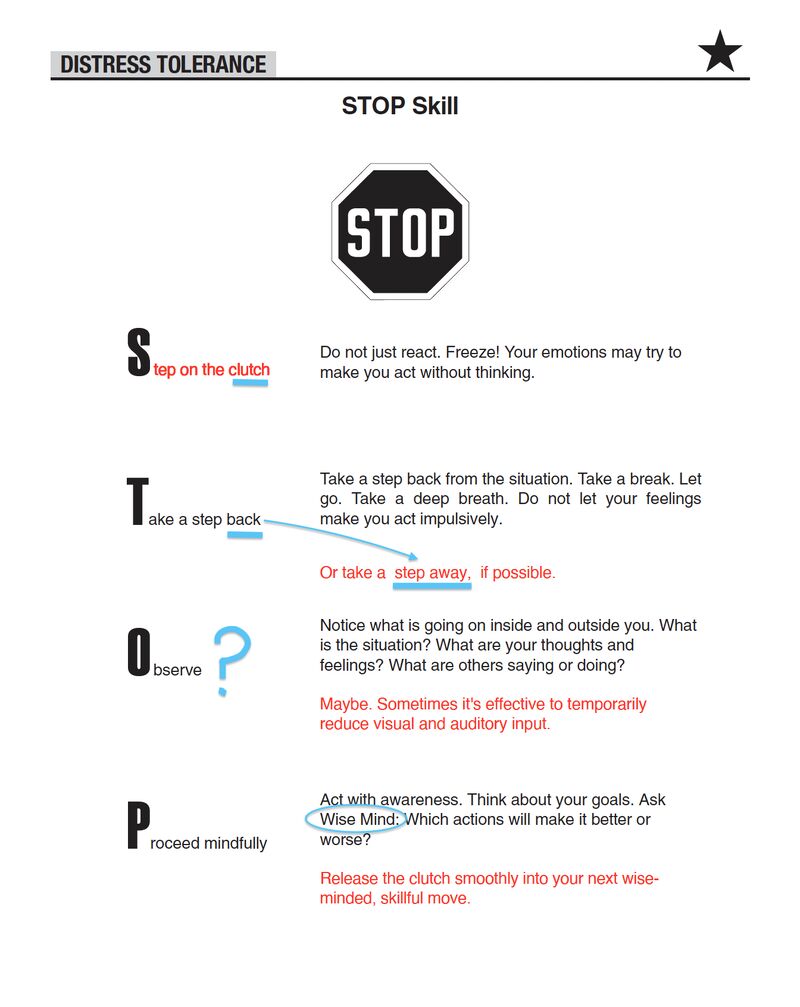
The STOP skill is a distress tolerance skill in Dialectical Behavior Therapy, or DBT. It helps people slow down before acting impulsively during intense emotions.
STOP stands for:
Stop
Take a step back
Observe
Proceed mindfully
Many people learn STOP as a way to pause before reacting. That is true, but I think the metaphor can go further.
To learn more about the basic STOP skill sequence, visit: https://dbt.tools/emotional_regulation/stop.php
STOP Skill as a Clutch
A metaphor I use is that STOP is like a clutch for shifting into and between skills.
Bonus: I get to teach teens how manual transmissions work.
It is a metaphor that just keeps giving. Starting on a steep hill. Using the wrong gear for the situation. Grinding gears. Getting a feel for the bite point.
I can keep going.
After lots of practice, STOP usually only takes 5 to 15 seconds. However, sometimes it takes several minutes, and I often wish I had taken longer.
In a crisis I handle well, I might press the clutch a dozen times, like a car chase scene from Fast & Furious.
When Observe Can Make Anger Worse
When I use STOP to reduce impulsive, anger-driven responses, I sometimes find one part of the handout counterproductive.
The handout often recommends observing what others are saying or doing.
However, during intense anger, I am more likely to misinterpret what I see and hear. Then Emotion Mind can use those judgments to fuel more anger.
Because of that, I often recommend taking a step away, ideally to another room.
In a professional setting, I might bow my head like a toy that ran out of batteries. At home, I might flop on a couch and throw my arm over my face.
Limiting visual and auditory input helps me access Wise Mind. It keeps me from gathering more evidence for why I should stay angry.
Using the STOP Skill With My Jeep
My daughter, wife, and cousin surprised me one day after work.
I found them removing all the stickers from my Jeep, including the Rubicon badge, the only one I had planned to keep. I had dreamed about having a Jeep since childhood.
In ten minutes, I used STOP at least six times.
First, I folded in half like a rag doll while I shifted into the Wise Mind decision not to express anger.
Then I closed my eyes, hugged my Jeep, and shifted into another skill.
STOP is not usually a clean pause. It is more like a clutch you keep pressing to shift gears without stalling out.
If your distress is at a 7, you may need at least 8 skills to get through the crisis. STOP often shows up several times in that sequence.
STOP Skill, Anger, and Wise Mind
The STOP skill matters because intense emotions can push people toward actions they later regret.
Anger can make urgency feel like truth. It can make immediate action feel necessary. It can also narrow attention until the only thing that seems obvious is the next angry move.
STOP creates a small opening.
In that opening, a person may step away, breathe, reduce stimulation, remember values, choose another skill, or avoid making the situation worse.
That small opening can change the whole direction of a crisis.
At YFI, we support youth, young adults, adults, and families navigating anger, anxiety, depression, OCD, PTSD, self-harm, suicide risk, ADHD, emotion dysregulation, family stress, and repeated crises. Our team provides comprehensive DBT, parent coaching, skills training, phone coaching, and coordinated care for clients and families who need more support. Learn more about our DBT services here: https://youthandfamilyinstitute.com/dbt/
For families and clinicians in Pasadena, San Marino, South Pasadena, La Cañada Flintridge, Arcadia, Sierra Madre, Glendale, La Crescenta, Claremont, and San Dimas, YFI provides evidence-based care with warmth, clarity, and respect. To learn more or connect with our team, please visit our contact page: https://youthandfamilyinstitute.com/contact/