ADHD and hustle culture can make exhaustion feel like proof of commitment. Sixteen years ago, I woke up on a bathroom floor in Beijing.
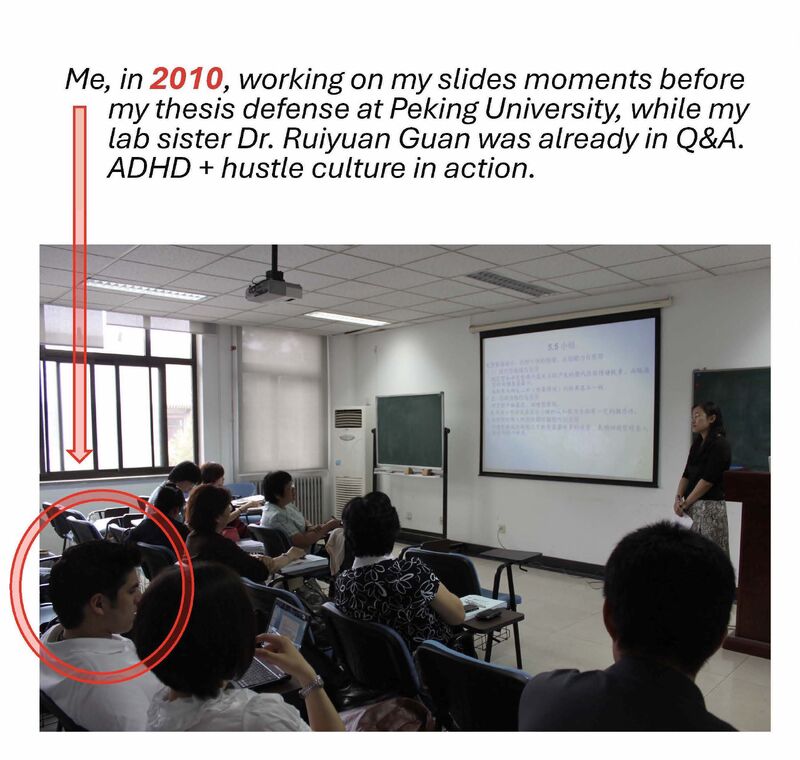
I had just submitted my master’s thesis to my advisor at Peking University. The statistics were brutal, and the literature review felt endless. However, the hardest part was writing it in Mandarin.
For weeks, I had been working without enough rest. Then, after an all-nighter, I went out to lunch with friends. Halfway through the meal, I ran upstairs to use the restroom.
For a moment, I could not understand what I was seeing. Until that day, I had only ever seen a urinal from above.
I had passed out.
Afterward, I pulled myself off the ground, cleaned myself up, and rejoined the group. I felt worried. At the same time, I also felt a tiny bit proud.
Back then, collapsing felt like proof of commitment. It felt like I had extracted every ounce of potential from my body.
That is hustle culture in action.
ADHD and Hustle Culture
What feels unsettling now is that I was already training to be a therapist. I was already helping clients improve their wellness, coping, and self-care behaviors.
Meanwhile, I was napping next to urinals, involuntarily.
ADHD can make this pattern harder to see. It is not only about distractibility. For many people, ADHD can involve uneven energy, urgency, shame, procrastination, perfectionism, and bursts of intense focus.
When those patterns meet hustle culture, exhaustion can start to feel virtuous. Rest can feel like failure. Listening to the body can feel like weakness.
Still, rest is not weakness.
It is information.
Burnout Is Not Proof of Commitment
I am deeply grateful for what I learned at Peking University. Since then, I have also become grateful for what my body kept trying to teach me.
Over time, I have learned to listen more carefully. I have learned to lean into my strengths. I have also learned to manage my ADHD with more honesty and less shame.
More importantly, I have learned that burnout is not proof that a goal matters.
Sometimes, burnout means the goal matters so much that we need a more sustainable way to pursue it.
That distinction matters for students, parents, clinicians, leaders, and anyone who has been praised for pushing past their limits.
ADHD, Values-Based Goals, and Sustainable Change
In DBT, we often talk about building a life worth living. However, that does not mean building a life where we ignore our bodies until they force us to stop.
Values-based goals require commitment. They also require pacing, self-awareness, recovery, and support.
For people with ADHD, this may mean creating more structure. It may also mean using skills before urgency takes over. In addition, it may mean asking for help earlier.
Most of all, it may mean noticing when intensity is being mistaken for effectiveness.
Sustainable effort is still effort.
To learn more about ADHD, readers can visit the National Institute of Mental Health overview here: https://www.nimh.nih.gov/health/topics/attention-deficit-hyperactivity-disorder-adhd
Learning With Less Collapsing
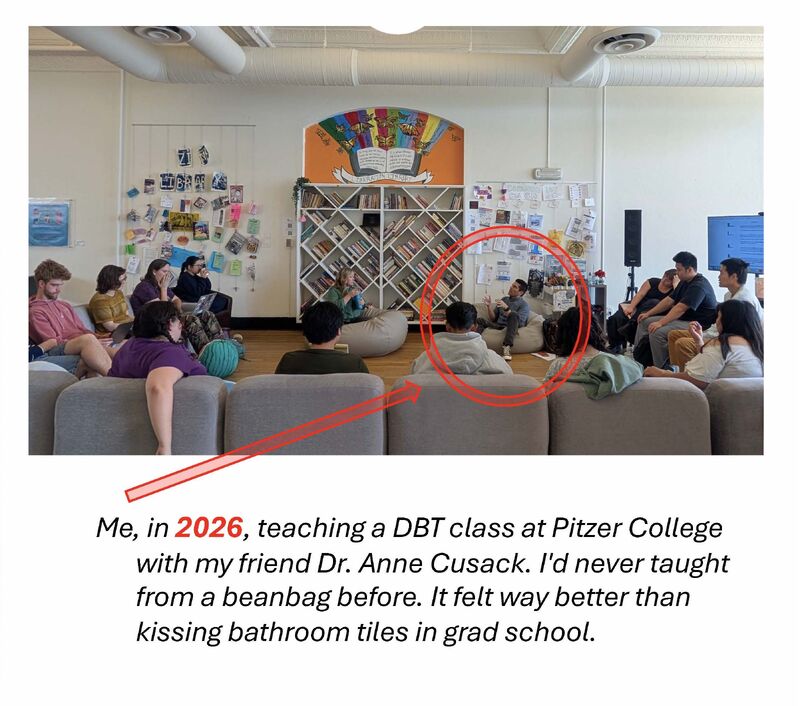
Recently, I taught a DBT class at Pitzer College with my friend Dr. Anne Cusack. I had never taught from a beanbag before.
It felt much better than kissing bathroom tiles in grad school.
Tomorrow is my birthday. I am grateful to be where I am. I am also curious who I will be 15 years from now.
Hopefully still here. Hopefully still learning. Hopefully still helping others do the same.
At YFI, we support youth, young adults, adults, and families navigating ADHD, anxiety, depression, OCD, PTSD, self-harm, suicide risk, emotion dysregulation, school stress, family stress, and burnout. Our team provides comprehensive DBT, parent coaching, skills training, phone coaching, and coordinated care for clients who need more support. Learn more about our DBT services here: https://youthandfamilyinstitute.com/dbt/
For families and clinicians in Beverly Hills, Brentwood, Sawtelle, Santa Monica, Mar Vista, Venice, South Pasadena, La Cañada Flintridge, San Marino, and Altadena, YFI provides evidence-based care with warmth, clarity, and respect. To learn more or connect with our team, please visit our contact page: https://youthandfamilyinstitute.com/contact/