
Cognitive defusion helps us relate differently to painful thoughts. Instead of treating every thought as a fact, cognitive defusion teaches us to notice thoughts as mental events that come and go.
For people struggling with shame, anxiety, or depression, cognitive defusion can create space between a painful thought and a person’s sense of self.
Last weekend, Marcus Rodriguez, PhD was at Stanford for the Duke men’s basketball game. Before tip-off at Maples Pavilion, he grabbed coffee with two former students who are now deep in their doctoral training.
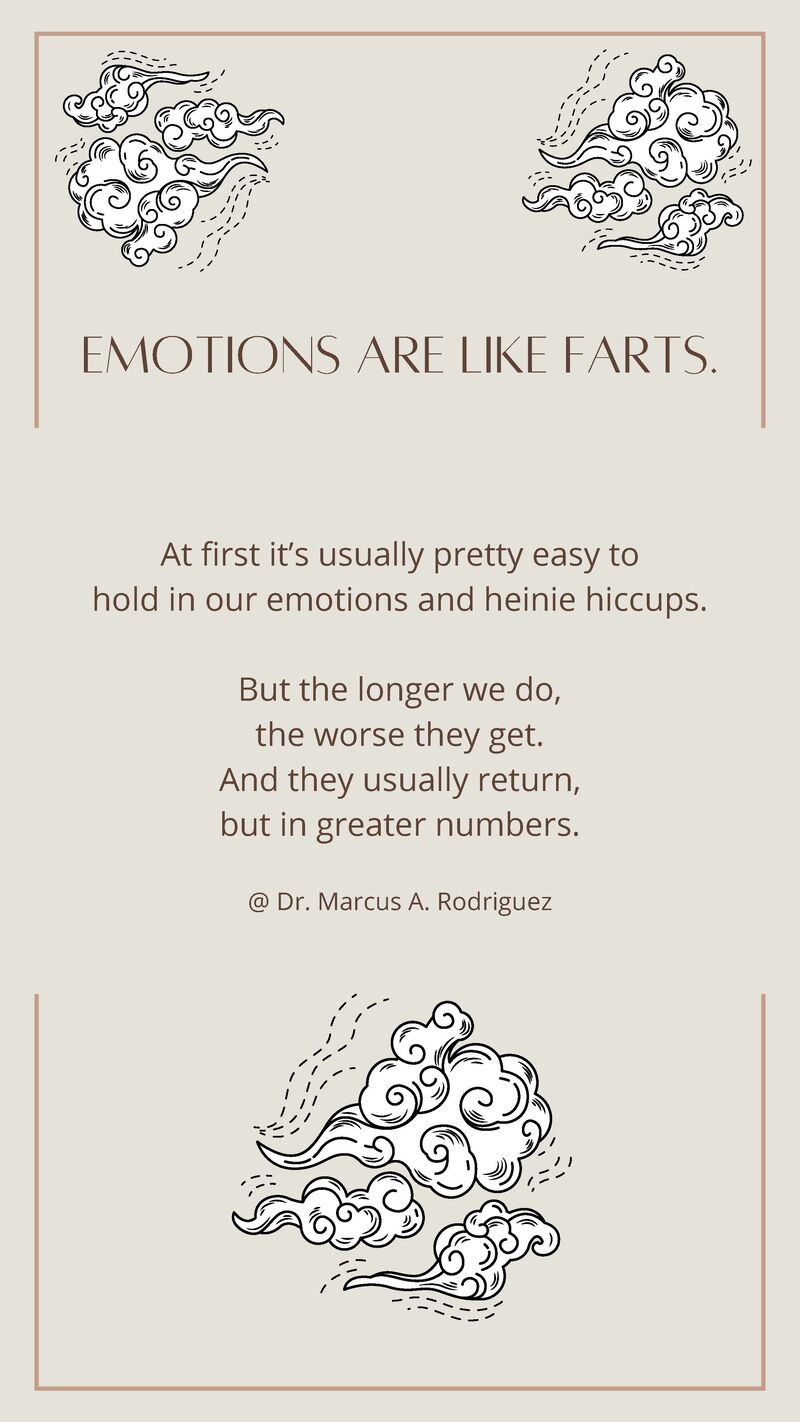
One of them, Juliana Gutierrez, shared a story about how she adapted something Marcus had once written: the idea that emotions, and sometimes thoughts, are like farts.
It was originally imagined as a children’s book.
Silly.
Crude.
Sticky.
And, as it turns out, clinically useful.
Cognitive Defusion and Shame-Based Thoughts
Juliana had shared the metaphor with a client who was fused with shame-based thoughts of worthlessness. His mind was producing painful thoughts, and those thoughts were getting in the way of doing something he deeply cared about.
So Juliana offered a simple metaphor.
Thoughts are like farts.
They can come out of nowhere. They can leave a nasty trace. But that does not mean you need to analyze the smell.
More importantly, just because your mind produced a thought, that does not mean you are the thought.
Later, when the client said, “I feel damaged,” Juliana responded with warmth and humor: “Dude, it sounds like you’re farting again.”
The client laughed.
Then he cried.
They were tears of relief.
For much of his life, he had believed his thoughts. However, in that moment, something shifted. He began to see that a thought could be painful, loud, and convincing without being the whole truth of who he was.
How Cognitive Defusion Helps Us Step Back
In Acceptance and Commitment Therapy, often called ACT, cognitive defusion is the practice of noticing thoughts as thoughts rather than becoming entangled with them.
The Association for Contextual Behavioral Science describes ACT as an approach that includes cognitive defusion, acceptance, mindfulness, values, and commitment methods. Learn more about ACT from ACBS here: https://contextualscience.org/about_act
This matters because shame thoughts often sound absolute.
“I’m damaged.”
“I’m worthless.”
“I’ll never be okay.”
“There is something wrong with me.”
These thoughts can feel powerful. As a result, many people spend years trying to argue with them, analyze them, suppress them, or prove them wrong.
Sometimes, though, healing begins with a different move.
Instead of asking, “Is this thought true?” we might ask, “Is this thought helping me move toward the life I want?”
That question creates space.
It does not require us to like the thought. It also does not require us to pretend the thought is harmless. Rather, it helps us see that we can have a thought without obeying it.
Using Humor in Cognitive Defusion
Of course, humor needs care. Not every painful moment calls for a joke, and not every client will respond to humor in the same way.
However, when there is trust, humor can soften shame. It can interrupt the grip of a thought that feels too heavy to question directly.
In this story, the humor did not minimize the client’s pain. Instead, it helped him step back from the thought long enough to see it differently.
That is the heart of cognitive defusion.
A thought may show up.
It may feel unpleasant.
It may leave a trace.
Still, it does not define you.
Cognitive Defusion, Shame, Anxiety, and Depression
Cognitive defusion can be helpful when shame, anxiety, or depression makes thoughts feel like facts.
A depressed mind may say, “Nothing will ever get better.”
An anxious mind may say, “I can’t handle this.”
A shame-filled mind may say, “I am broken.”
These thoughts can be painful. They can also feel very convincing. However, cognitive defusion helps people relate to thoughts with more flexibility.
The goal is not to erase every painful thought. Instead, the goal is to notice the thought, make room for it, and choose what matters next.
At Youth and Family Institute, we support children, teens, young adults, parents, and families navigating anxiety, depression, OCD, PTSD, self-harm, suicide risk, ADHD, shame, emotion dysregulation, and related emotional challenges. Our clinicians provide evidence-based care, including DBT, parent coaching, skills training, phone coaching, and coordinated care when clients and families need more support. Learn more about our DBT services here: https://youthandfamilyinstitute.com/dbt/
For families and clinicians in Brentwood, Sawtelle, Santa Monica, Mar Vista, Venice, Pacific Palisades, Beverly Hills, Malibu, Manhattan Beach, South Pasadena, La Cañada Flintridge, San Marino, Altadena, Newport Beach, Rancho Palos Verdes, Palos Verdes Estates, Laguna Beach, and surrounding communities, YFI provides evidence-based care with warmth, clarity, and respect. If painful thoughts, shame, anxiety, or depression are getting in the way of your life or your child’s life, support is available. Contact Youth and Family Institute here: https://youthandfamilyinstitute.com/contact/